USDD Expands Beyond TRON With WBTC Vaults, Unlocking Low-Cost Bitcoin Liquidity and Yield Opportunities

We'd love your feedback.
In today’s market environment, crypto users are navigating a difficult balance. Volatility remains elevated, while yields across many platforms have gradually declined. As a result, users are increasingly looking for solutions that allow them to preserve exposure to high-quality assets while still generating consistent returns.
However, most existing options force a compromise. Holding Bitcoin provides long-term upside but limits liquidity and yield opportunities. On the other hand, deploying capital into yield strategies often requires selling or reallocating core assets.
USDD addresses this gap with the introduction of WBTC Vaults, a system designed to allow users to unlock liquidity from Bitcoin while maintaining exposure, all within a structured and overcollateralized framework.
Access the USDD WBTC Vault
Introducing WBTC as a Core Collateral Asset
The addition of WBTC marks a significant step in the evolution of the USDD protocol. WBTC has been one of the most widely adopted representations of Bitcoin within decentralized finance since 2019, enabling BTC liquidity to move across multiple ecosystems.
By integrating WBTC, USDD expands beyond TRON-native collateral such as TRX and sTRX, introducing a globally recognized and highly liquid asset into its collateral base. This shift is not only about adding variety but about strengthening the protocol’s overall credibility and resilience.
WBTC’s deep liquidity across both centralized and decentralized markets ensures ease of access, while its transparency and established track record make it one of the most trusted forms of tokenized Bitcoin.
Image type: WBTC ecosystem / BTC representation visual
How the WBTC Vault Works
The WBTC Vault allows users to deposit WBTC as collateral and mint USDD against it. Once USDD is minted, users can deploy it across various yield strategies, including looping strategies on Morpho and boost campaigns via Binance Web3 Wallet, GateDex and other campaigns. This creates a system where capital becomes more efficient without requiring asset liquidation.
This structure enables users to maintain their Bitcoin exposure while simultaneously unlocking liquidity. Instead of choosing between holding and earning, users can now achieve both within a single framework.
The simplicity of the process ensures accessibility, while the underlying mechanics provide flexibility for both basic and advanced strategies.
Dual Vault Structure: Balancing Risk and Efficiency
To accommodate different user preferences, USDD introduces two distinct WBTC Vault configurations:
- WBTC-A (Conservative Option)
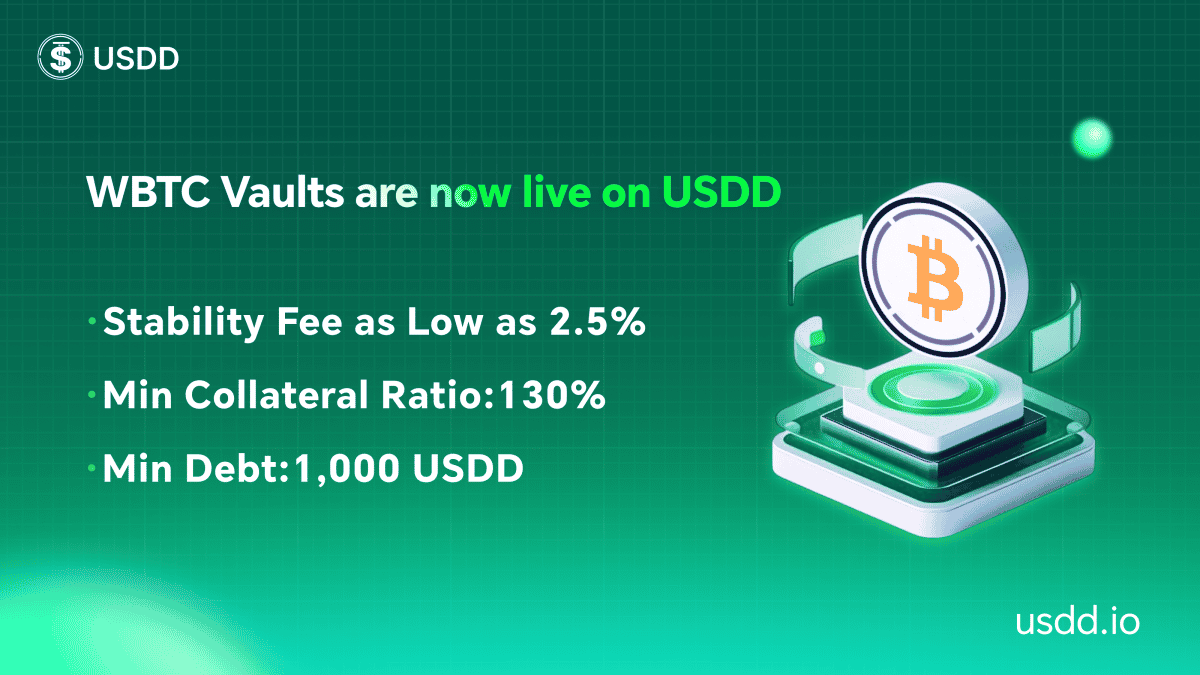
Designed for users prioritizing stability, this vault requires a 150% collateral ratio and offers a lower stability fee of 2.5%. It provides a safer borrowing environment with reduced liquidation risk. - WBTC-B (Efficiency-Focused Option)
This vault offers a lower collateral requirement of 130%, allowing for higher capital efficiency. With a stability fee of 3.5%, it is better suited for users seeking more aggressive strategies and higher leverage.
This dual-structure approach ensures that users are not confined to a single risk model. Instead, they can actively choose a configuration that aligns with their strategy and risk tolerance.
Cost Efficiency Compared to Existing DeFi Models
One of the defining advantages of the WBTC Vault is its cost structure. With borrowing rates starting as low as 2.5%, USDD positions itself as a highly competitive option within the DeFi landscape.
Traditional CDP-based systems often carry significantly higher borrowing costs, while lending markets typically fluctuate depending on demand and liquidity conditions.
By maintaining relatively low and stable borrowing fees, USDD enables users to access liquidity more efficiently, reducing the cost of executing strategies such as leverage or yield deployment.
Strategy Enablement: Unlocking Advanced Use Cases
Beyond basic borrowing, the WBTC Vault introduces opportunities for more advanced strategies.
The first is the leveraged accumulation strategy, often referred to as the “Long Loop.” In this scenario, users deposit WBTC, mint USDD, convert that USDD into additional WBTC, and repeat the process. This allows users to increase their Bitcoin exposure without introducing new capital.
The second strategy focuses on yield arbitrage. Users can borrow USDD at a relatively low cost and deploy it into higher-yield opportunities across DeFi platforms. The difference between borrowing cost and yield becomes net return, allowing users to generate additional income from otherwise idle collateral.
These strategies transform the vault from a simple borrowing tool into a broader capital efficiency mechanism.
Lending/APY comparison (Aave / DeFi rates table)
Strengthening the USDD Protocol Through Collateral Expansion
The integration of WBTC has important implications at the protocol level.
First, it introduces collateral diversification. By incorporating Tokenized Bitcoin assets, USDD reduces its reliance on a single ecosystem, creating a more balanced and resilient collateral structure.
Second, it lowers correlation risk. WBTC behaves differently from TRON-native assets, helping stabilize the system during periods of market volatility.
Third, it enhances performance under extreme market conditions. Bitcoin’s global liquidity and strong market consensus provide an additional layer of support during stress scenarios, improving the protocol’s overall robustness.
Together, these improvements position USDD as a more stable and scalable system over the long term.
How to Participate in the WBTC Vault
Participation in the WBTC Vault is designed to be straightforward and accessible. Users can begin by visiting the USDD Vault interface, connecting their wallet, depositing WBTC, and minting USDD. The process is streamlined to minimize friction while maintaining transparency.
For users operating on other networks, WBTC can be transferred to the TRON network through supported bridging solutions before accessing the vault.
Start using the USDD WBTC Vault
Conclusion: A Strategic Shift Toward Bitcoin-Aligned DeFi Infrastructure
The launch of WBTC Vaults represents more than just a new feature within the USDD ecosystem. It reflects a broader strategic direction focused on improving capital efficiency, expanding collateral diversity, and aligning with globally recognized assets.
By combining low borrowing costs, flexible risk structures, and advanced strategy support, USDD is positioning itself as a more comprehensive liquidity layer within DeFi.
As the market continues to evolve, solutions that allow users to retain asset exposure while unlocking additional value are likely to play a central role. The WBTC Vault is a clear step in that direction.
This post is commissioned by Blockman and does not serve as a testimonial or endorsement by The Block. This post is for informational purposes only and should not be relied upon as a basis for investment, tax, legal or other advice. You should conduct your own research and consult independent counsel and advisors on the matters discussed within this post. Past performance of any asset is not indicative of future results.
Disclaimer: The Block is an independent media outlet that delivers news, research, and data. As of November 2023, Foresight Ventures is a majority investor of The Block. Foresight Ventures invests in other companies in the crypto space. Crypto exchange Bitget is an anchor LP for Foresight Ventures. The Block continues to operate independently to deliver objective, impactful, and timely information about the crypto industry. Here are our current financial disclosures.
© 2026 The Block. All Rights Reserved. This article is provided for informational purposes only. It is not offered or intended to be used as legal, tax, investment, financial, or other advice.